
 Search in database (English)
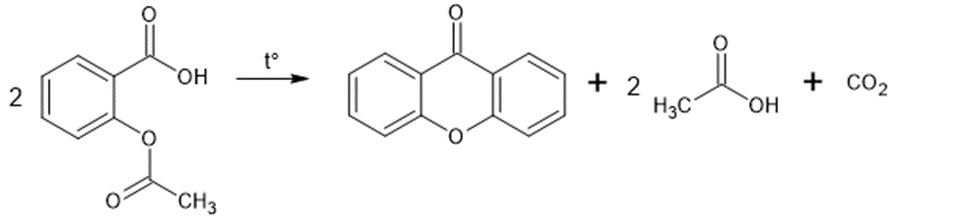
The operation is carried out in a small flask of 125 cm³, for example, the neck of which bears laterally a side tube of the same diameter as the neck, fused on at a point 4 or 5 cm from the flask, and approximately 30 cm in length. The side tube fits freely into the neck of a flask provided with a side arm connected, by means of its side arm, to a trap intended to carry away the pungent vapours (acetic acid) or malodorous vapours (phenol) which are formed during the operation.
The aspirin is introduced into the flask, 30 to 35 g for a flask of the indicated capacity, and it is heated rather rapidly over a naked flame with a Bunsen burner held in the hand. The aspirin melts and then decomposes. The carbon dioxide evolved carries along the acetic acid and phenolic vapours; at about 350 °C, the xanthone distils and condenses in the fused lateral tube in the solid state; it is for this reason that the tube should be of fairly large diameter. The xanthone thus obtained is generally coloured and contaminated with odorous products. A brief washing with a dilute solution of sodium hydroxide, followed by washing with water, then with a little alcohol, removes the colour and odour. The xanthone is then ready to be converted into xanthydrol. If it is desired to obtain it in beautiful crystals, it is caused to crystallize by cooling its solution in hot aqueous alcohol. From 30 g of aspirin there are obtained approximately 6.5 g of pure xanthone, corresponding to 40% of the theoretical yield.
Notes
1. One may, of course, carry out the operation in a small tubulated retort fitted with an adapter.
2. The operation should not be followed by introducing a mercury thermometer into the flask: xanthone boils at 350 °C.
3. It is not recommended to modify the technique either by operating under reduced pressure or by combining the acetylsalicylic acid with various substances in the hope of improving the yield by directing the reaction employed. The only advantageous modification consists in operating in a current of carbon dioxide. The crude yield may then reach 75%, and the yield of pure xanthone may then reach 60%.
© Collected Ruslan Anatolievich Kiper, burewestnik@mail.ru